You take the blue pill - the story ends, you wake up in your bed and believe whatever you want to believe. You take the red pill - you stay in Wonderland, and I show you how deep the rabbit hole goes.
Welcome to my first academic blog post! Since I have started my Linear Algebra course, I'll try to write about some of the concepts I have learnt in class, and hopefully it will help my own understanding as well as others who are interested in the topic.
Linear Algebra?!
Okay, hold your horses. I know it sounds like a scary subject, but
it's actually quite fascinating! At its core, it's a branch of math
that deals with vectors, spaces, and transformations. Basically
everything that has to do with lines and planes. This is super useful
in various fields like computer science, physics, engineering,
biology, economics, and more, because it's essentially
everywhere. If you can break something down into a bunch of
equations, chances are linear algebra will be there to help you solve
it!
To see how, let's look at a classic college problem that
everyone will experience.
Exhibit A: Money? What money?
Imagine that you will be hosting a party at your house, where you have invited tons and TONS of your fellow college friends. Since you are a college student, you are very short on money. Thus, you will want to buy party supplies at a relatively cheap price.
First, every good party you went to needs two things: snacks and drinks. You write down the shopping list as following:
- Drinks: the number of soda packs (\(x\))
- Snakcs: the number of snack bundles (\(y\))
Now that you have your list, you travel to the nearest store and found
out that each soda pack costs 8 bucks, and snack bundle costs 16
bucks.
(Hmm... okay. Not too shabby.)
Next, you checked your
wallet and realize that you have only $160 to spend on these two
things.

So now, your budget will be...
You know that you can't buy just one of them to keep your party alive. Let's say that from the guest list, we need a minimum of 15 items.
Okay, now you might be stuck here. How do you find specific values of \(x\) and \(y\) that satisfies both constraints? Even better, how do you find the combination that saves you the most money while still satisfying your guests?
This is where linear alegbra steps in! By modeling the problem as a system of equations, We can use it to calculate the exact combination that fits all the rules above and keeps your wallet high and dry!
Solving the Problem
First, let's rewrite the equations above into a more standard form:
We can rearrange the equations to express \(y\) in terms of \(x\):
Then, we do the same for the price equation:
Now, the equations can now be drawn on a 2D graph! As shown below:
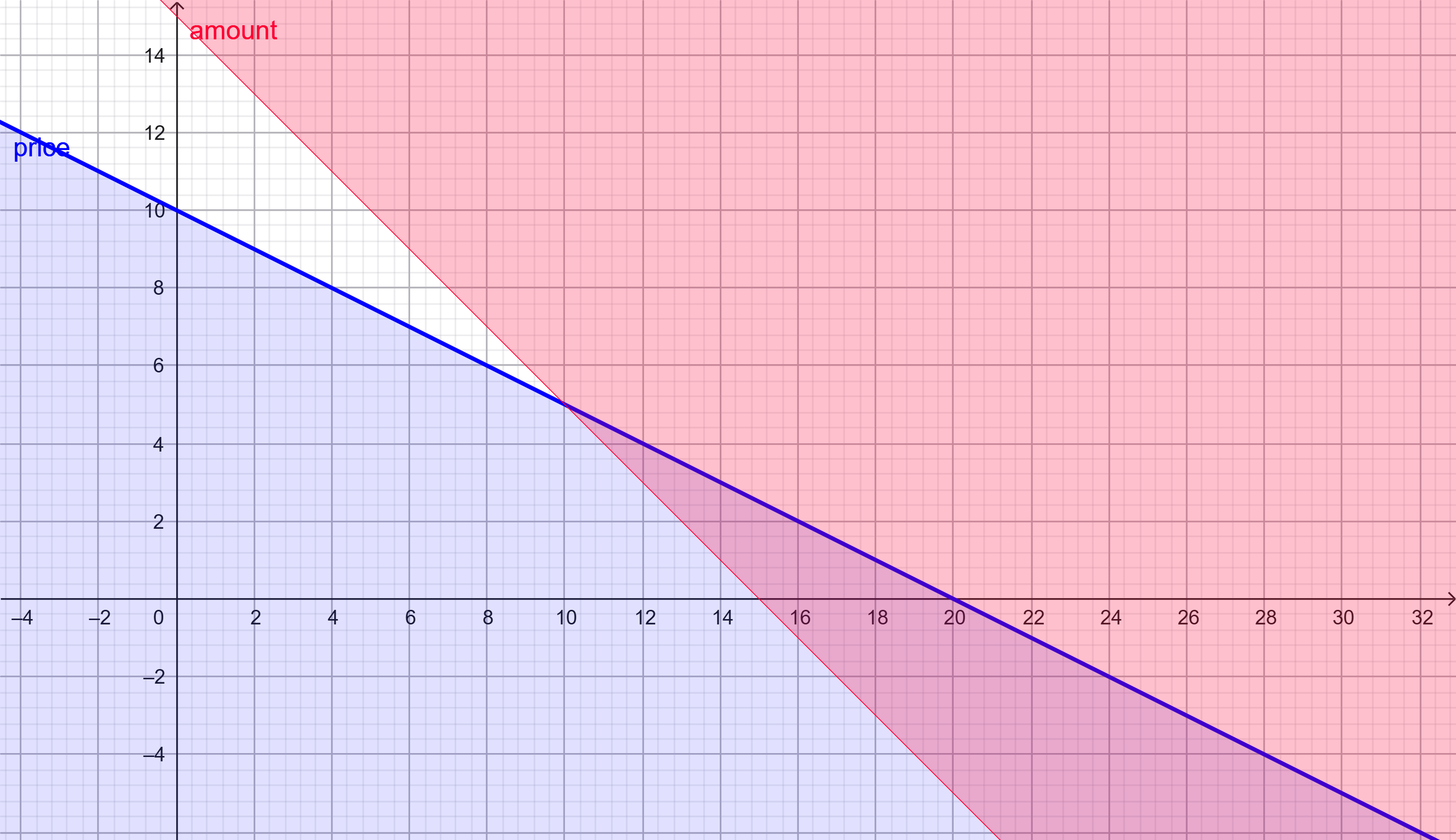
From the graph, we can tell that the two lines intersect at a point. This point represents the solution to our problem, where both equations are satisfied simultaneously. By solving the equations, we find that the intersection point is at \(x = 10\) and \(y = 5\). This means that you should buy 10 soda packs and 5 snack bundles!
You can also see that there's a shaded region that overlaps on the graph, which also tells us other possible combinations that satisfies the conditions. However, the intersection is still the best choice, as it maximizes the number of items while staying within our budget.
Final Verdict: Linear Algebra is Awesome!
And there you have it! A simple example how linear algebra can be used to solve real world problems. Do note that this is just the tip of the iceberg when it comes to linear algebra. It has many many more applications outside of just solving equations. From machine learning, large language models (yes, ChatGPT!), to computer graphics, it is one of fundemental tools that help carry our modern world.
In future posts, I will dive deeper into the concepts of vectors, matrices, and transformations *shivers*. Maybe those will be useful your next party planning session...
Until then, stay curious and keep on learning! :-)
- VF